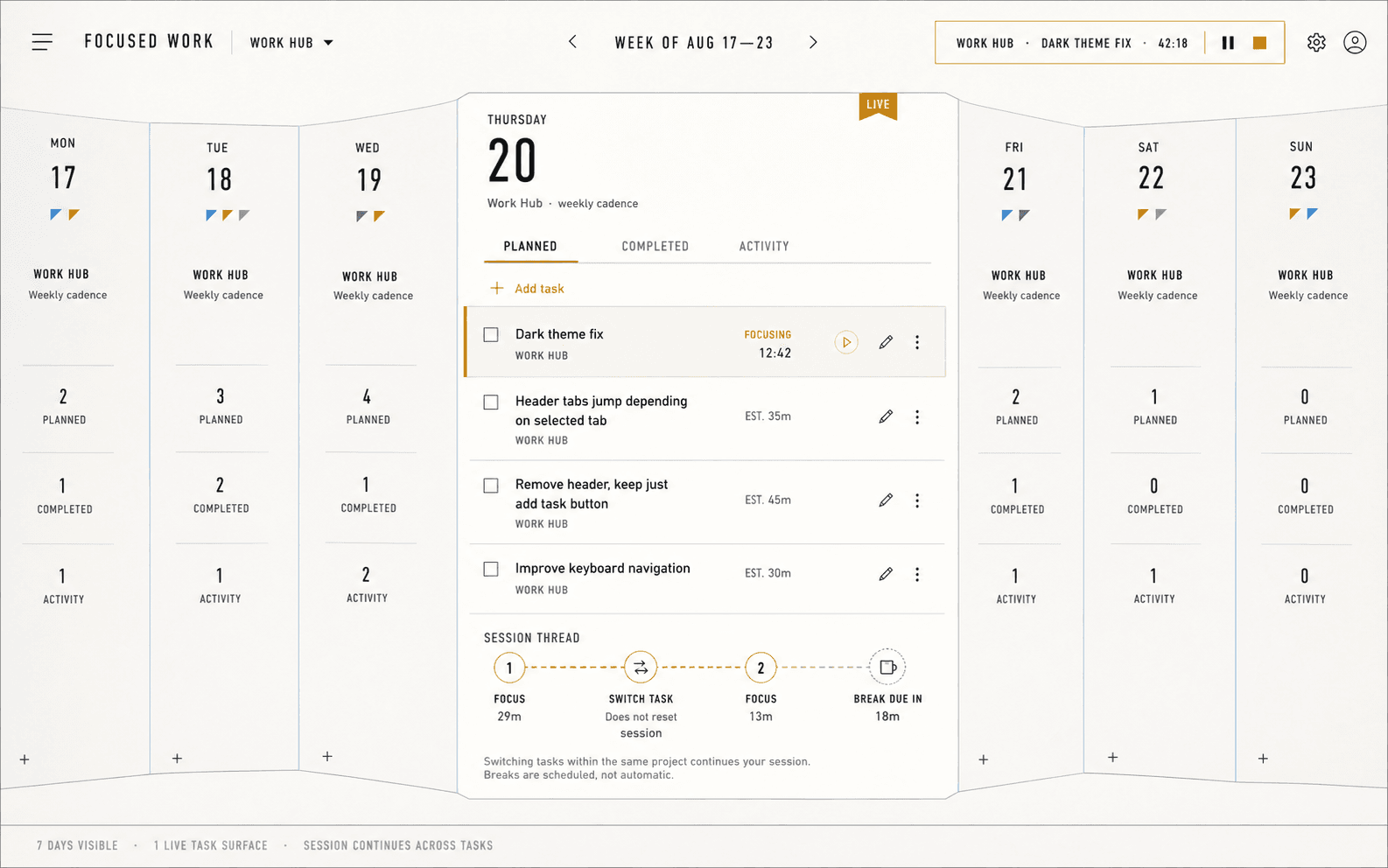
Plan a week without scheduling every minute.
A useful weekly planner gives work a date and a project context while leaving enough space for reality. The goal is not a perfect forecast; it is a visible, revisable set of commitments.
- One horizon
- Keep Monday through Sunday present so a change on one day is understood in the context of the whole week.
- Project cadence
- Use recurring project days as a default rhythm, then make explicit exceptions when a week changes.
- One active day
- Expand only the day you are working with; neighboring days provide context instead of competing for attention.
Begin with project rhythm
Start by deciding which projects normally receive attention on which weekdays. A cadence is a planning default, not a promise that every Monday will look identical.
This makes empty days informative: they show available capacity or an intentional break rather than an incomplete to-do list.
Schedule outcomes, not categories
Place a concrete next action on a day: prepare the proposal, review the release, draft the article. A project name alone does not tell you what completion looks like.
Keep genuinely uncertain work in an Unscheduled group. Moving it onto a date should be a deliberate action that can also be done from a cross-week task inventory.
Re-plan without erasing evidence
When the week changes, move the task rather than duplicating it. Completion and focus history should remain attached to the real task and project.
At the end of the week, review what was completed and where focused time went. Use that evidence to adjust the next cadence instead of assigning yourself a productivity score.